To find free school uniform in the UK, start with your child's school, a local uniform bank and families passing on outgrown clothes. If buying the missing pieces is still difficult, check the support available in your part of the UK. Some schemes provide clothing, some offer discounted second-hand items, and others are grants with eligibility rules.
You do not need to wait for the summer holidays to ask. A child can outgrow trousers or lose a jumper halfway through term. The most useful request is specific: the garment, size, colour and any school requirement, rather than a whole new wardrobe.
This guide covers where to ask and what to check before collecting. Official support pages were checked on 13 November 2026; use the linked scheme for current eligibility and application dates.
Ask the school before searching further away
Contact the school office or parent-teacher association and ask whether there is a uniform cupboard, swap rail, donation bank or second-hand sale. Ask which items are free and which have a charge. A second-hand scheme is not necessarily a free scheme.
In England, GOV.UK school uniform guidance says schools should make second-hand uniforms available and publish information about obtaining them on their website. If you cannot afford the required uniform or PE kit, speak to the headteacher about support.
Check the actual uniform policy too. A plain navy cardigan may be useful, while a different school's embroidered jumper may not be. Ask whether a plain item is acceptable before travelling to collect it.
Here is an example message you can adapt:
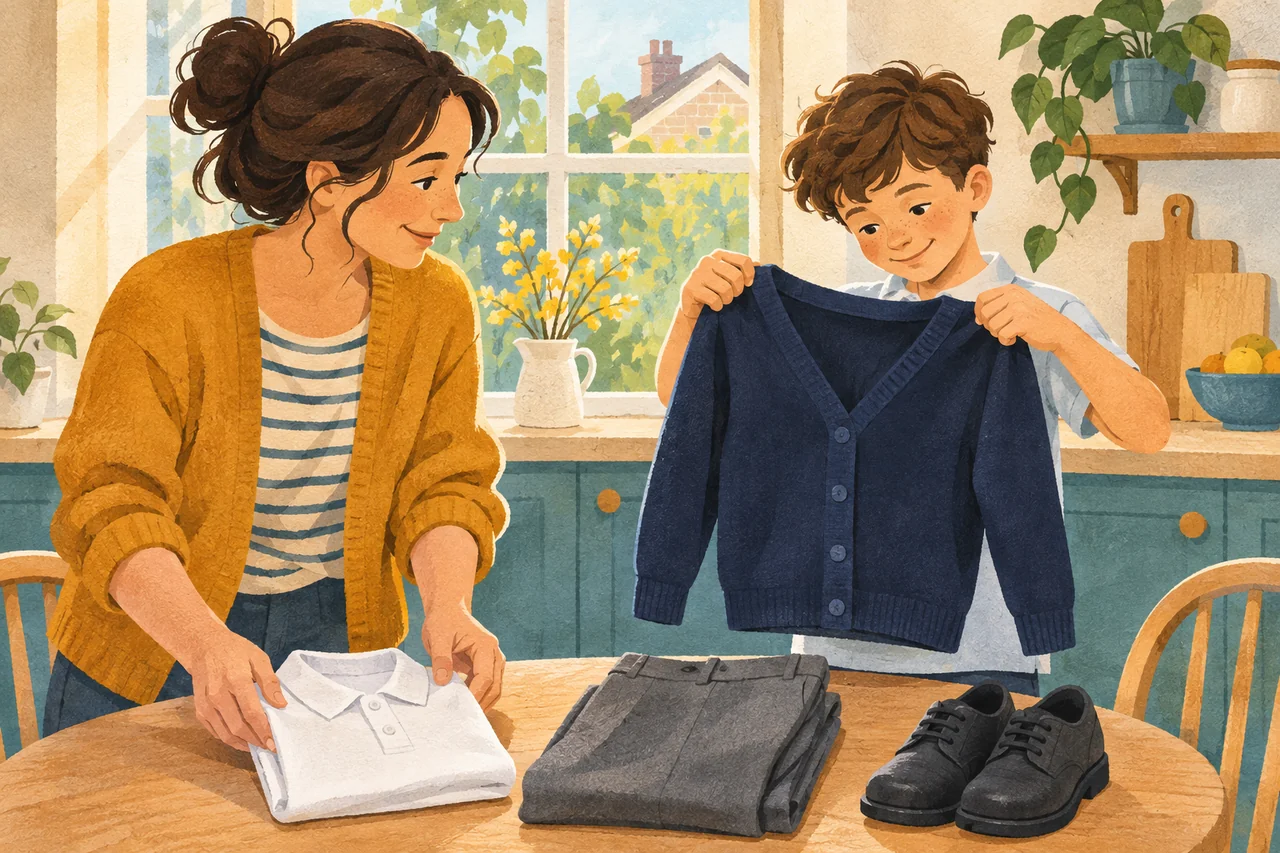
Hello, I am looking for a navy cardigan and grey trousers in age 6-7. Does the school have any donated uniform or a second-hand scheme? Please could you also confirm whether a plain cardigan is allowed?
Keep your child's personal details out of public posts. The school can discuss individual support privately.
Check local uniform banks and community schemes
Search your council's website for school-uniform support, or ask the school which nearby scheme it uses. Community centres, family hubs and local reuse groups may know about a uniform bank or a planned swap.
Before visiting, check three things:
- Whether the scheme accepts families from your area or school.
- Whether it has the size and garment you need now.
- Whether collection needs an appointment, referral or payment.
Do not assume that every council runs a grant or that every donation point has a shop you can browse. For example, Rochdale's guidance says the council does not provide a school-uniform grant and directs families to other routes, including their school.
If the need is urgent, tell the school what is missing and when it is needed. Waiting for an unconfirmed offer in an app is not a substitute for asking about immediate help.
Look for clothing another family has outgrown
Plain shirts, trousers, skirts, cardigans and coats can pass between households when the size and school rules fit. On YoungPlanet, the items are free; you request an item and agree the handover with the person sharing it. Optional membership is separate from free sharing and does not guarantee an item.
Start with the current free children's clothes. You can browse public listings without signing in; sending a request needs an account. This category includes different types of clothing, not just school uniform. Open the actual listing and check its description rather than assuming that a category or photo proves the size, colour or school suitability.
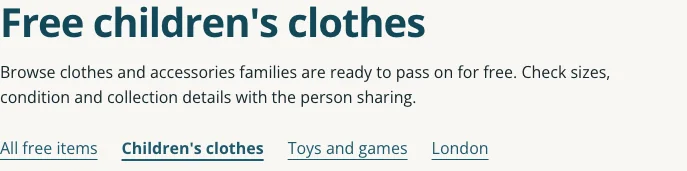
For a useful enquiry, ask whether the garment is still available, which size is on the label, whether the fastening works and where collection can be arranged. A request is not a reservation or a guarantee. Confirm the handover before making a journey.
If nothing suitable is listed, keep the school and community routes open. For babies and younger children who do not need uniform, see our separate guide to finding free baby clothes in the UK.
Check help with uniform costs in your UK nation
A clothing grant helps with costs; it does not mean every family can receive free uniform. Use the official application route and check its current rules.
| Where you live | Official starting point | What to check |
|---|---|---|
| England | GOV.UK school uniform and your council | Whether local help exists; ask the school about hardship and second-hand options |
| Scotland | School clothing grants | Your council's eligibility, application window and award |
| Wales | School Essentials Grant | Qualifying circumstances and how to apply through the relevant local authority |
| Northern Ireland | Education Authority uniform grants | Eligibility, supporting documents and the current school-year application |
Being offered a universal school-meal scheme does not necessarily mean you qualify for another payment. Check each grant's own criteria, and ask its provider if your circumstances are unclear.
Check a second-hand uniform before collection
Use this short checklist to avoid bringing home something that cannot be used:
- School requirements: right colour, style and any required badge; ask about plain alternatives.
- Size and fit: labelled size, useful measurements and room to move. Shoe fit needs checking in person.
- Condition: working zips and buttons, usable seams, soles and cuffs. Ask about marks or repairs.
- Contents: exactly which pieces are included in a bundle, including whether PE kit is part of it.
- Collection: a confirmed place and time that you can manage; check any postage arrangement separately.
Wash suitable garments according to their care labels. Remove old personal-name labels before the next child uses them. For more handover tips, read how to give away children's things.
Pass the next size on when you are finished
If you have usable uniform to give, ask the school whether it currently needs those sizes. School-specific items are often most useful within the same school community. For plain items another local family could use, list the uniform on YoungPlanet with the size, colour, contents and condition.
A useful example title is “Navy school cardigans, age 6-7, two included”. It is an example, not an available listing. Use your own details, photograph the actual pieces and remove personal-name labels before taking photos.
For smaller clothes, our guide to where to donate baby clothes explains the difference between direct family sharing, baby banks and charity shops.
← Back to the blog