
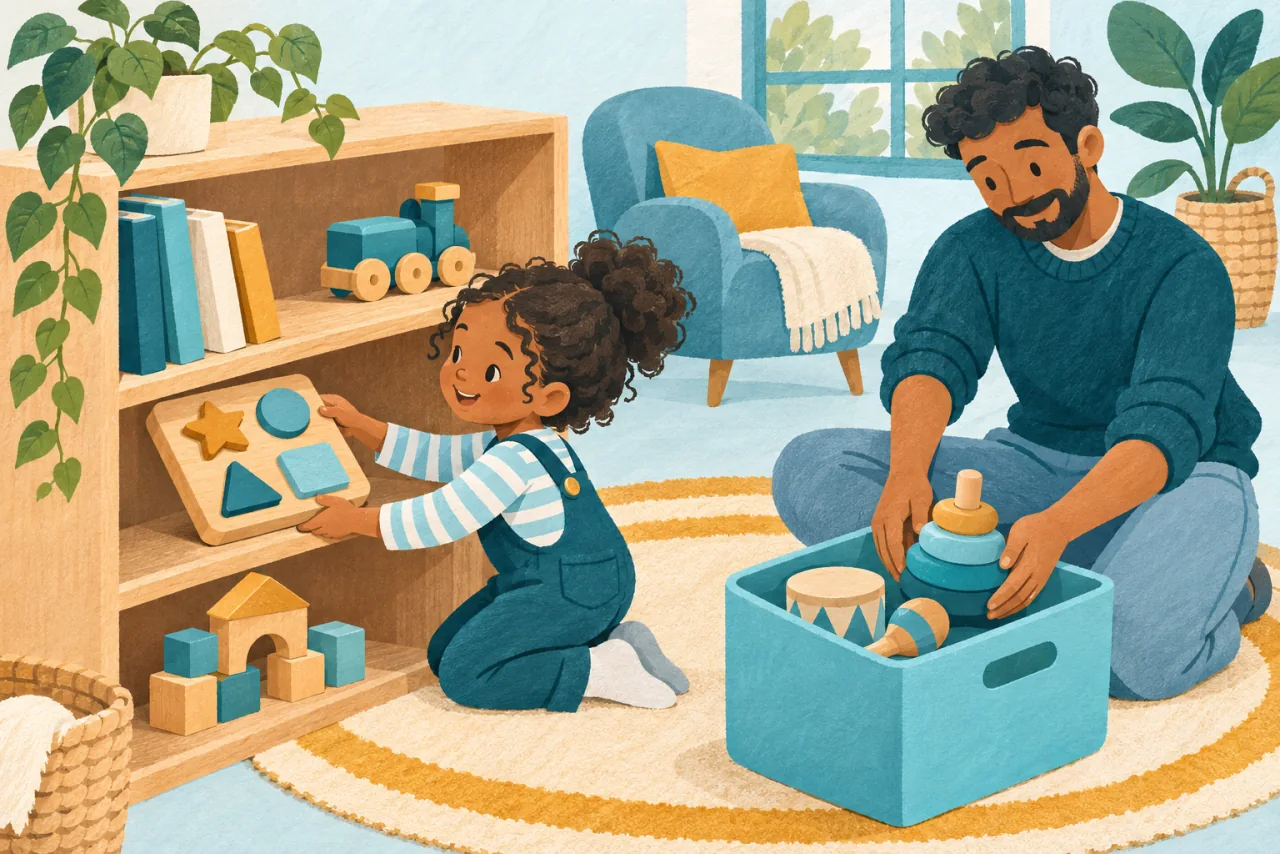
Toy rotation means keeping some toys available and storing others, then changing the selection when it suits your household. It is a way to organise what you already own. You can try it with one shelf and one existing box, without buying a storage system or following a fixed number of toys.
The purpose is to make the play space easier to use. A toy your child reaches for every day can stay out, and a rotation does not need to happen on a particular day of the week.
Decide what you want the space to do
Start with the problem you can see. Are pieces from different games mixed together? Is a large toy blocking the route to a cupboard? Are books difficult to reach because another box sits in front of them?
Choose one small outcome, such as keeping the floor clear enough to play or making complete activities easy to find. This gives you something practical to check after trying a different arrangement.
Toy rotation is not a promise about attention, behaviour or development. Children have different interests, and a tidy-looking shelf is not a measure of how well they are playing. Keep the arrangement if it helps your family; change it if it creates extra work.
Bring complete activities together first
Before choosing what stays out, reunite pieces and accessories. Put the board with its playing pieces, collect the train track in one place and return borrowed toys to their owners.
Check the condition of items as you go. Separate broken pieces from toys still in use and follow manufacturer instructions for cleaning and care. Storage is not a fix for a known safety problem.
Books can be part of the same exercise. Put current bedtime choices within reach and keep the rest somewhere dry and easy to find. If your family has moved on from a set, a children's book swap may be more useful than keeping it indefinitely.
Choose the first selection around current interests
Look at what your child actually chooses. You might keep building pieces, a pretend-play set, a puzzle and a few books out. Those are examples, not categories every family must fill.
Make each activity easy to recognise. If a box holds several unrelated sets, separate them using containers you already have, provided they suit the space and your child's access needs. Avoid buying organisers until you know what needs organising.
Consider how your children share the room. A younger child and an older sibling may need different arrangements. Follow the age suitability and warnings on the toys, and keep items with small parts away from children for whom they are unsuitable.
Keep room for play as well as storage. A shelf packed edge to edge can look organised while leaving nowhere to put a puzzle down.
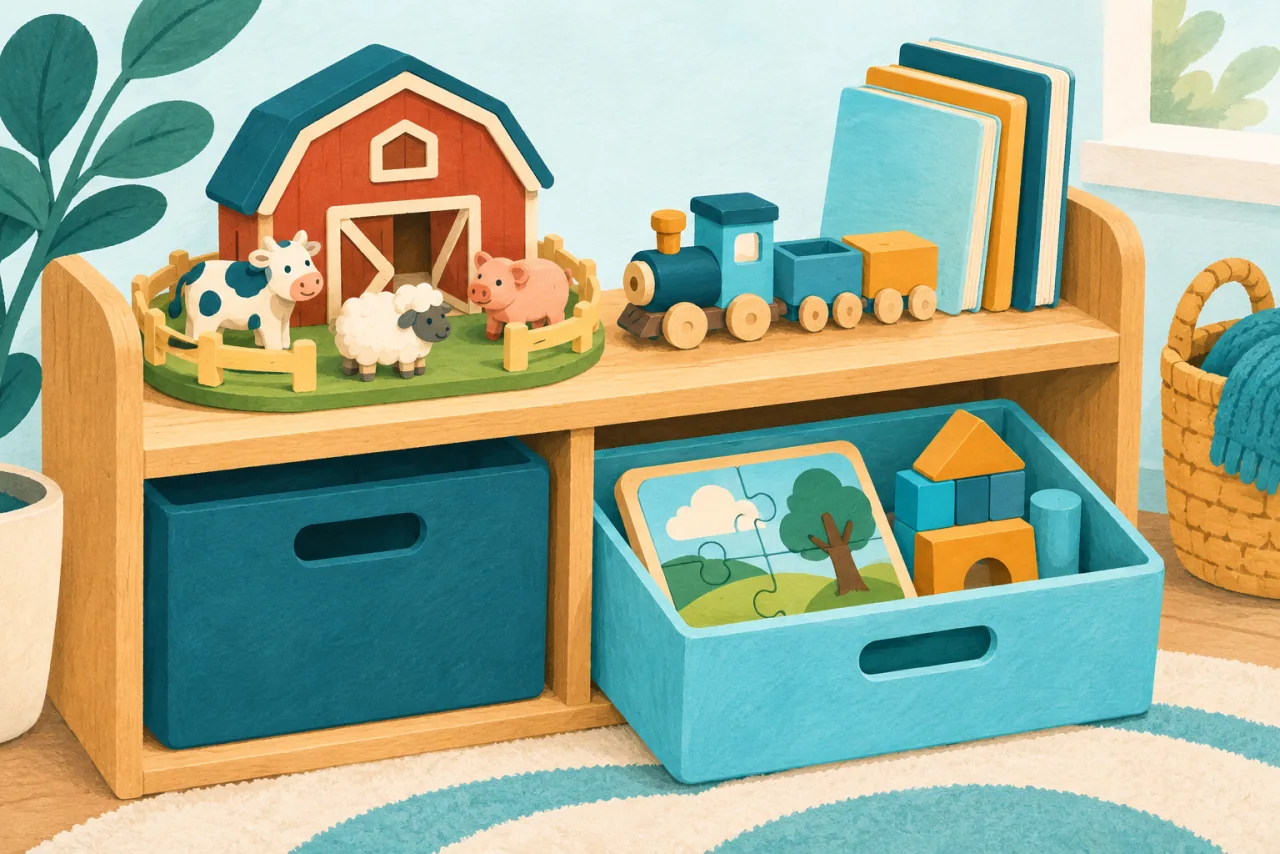
Store the rest so you can find it again
Use a simple label that tells you what is inside. "Farm animals and barn" is easier to act on than "Box 3". Keep related pieces together and note anything that needs a separate accessory.
Store boxes securely and appropriately for your home. Keep them out of places where retrieving them becomes a difficult job. If you cannot access the stored toys easily, the system may be more demanding than it is useful.
A phone note or a short list inside a cupboard can help you remember what is available. You do not need to catalogue every piece. Just record enough to avoid buying a duplicate because you forgot where the original went.
Change the selection when there is a reason
You could swap an activity when your child asks for it, when a current set is being overlooked or when your family has time for a change. There is no universal weekly or monthly schedule.
An illustrative first rotation might look like this:
- Leave the favourite vehicles and drawing materials available.
- Put away a puzzle your child has finished with for now.
- Bring out a different puzzle with all its pieces together.
- Turn a few overlooked picture books to face forward.
- Ask whether the new arrangement makes it easier to find things.
Change one or two things initially. If everyone is looking for a toy that has been put away, bring it back and adjust the plan. The system should serve your household's routines.
What if your child wants to keep everything out?
Invite them to make a small choice: which puzzle should be ready on the table, or which books should go beside the bed? Explain where the other things will be and how they can ask for them.
Do not use rotation as a surprise clear-out. Keeping something out of sight temporarily and giving it away are different decisions. Make that distinction clear, especially with toys that hold memories.
If storing a large reserve would simply create another cluttered space, try a smaller shelf rearrangement instead. You can still group complete activities and make favourites easier to reach.
Decide what is ready to leave the rotation
After trying the arrangement, you may notice toys your family no longer wants to store or use. Set those aside for a separate conversation, then check their condition before offering them.
Our pre-Christmas toy declutter plan helps separate keep, share and repair decisions. When a toy is ready for another home, the listing guide explains how to show its condition and contents clearly.
If an item is beyond repair, use Recycle Now's toys and games guidance to check the next step rather than adding it to household recycling by assumption.
For suitable items your family has finished with, YoungPlanet's free marketplace is one way to arrange a new home. Keep the toys you use, rotate only what you can manage and let the shelf change with your family.
Try one shelf before reorganising the whole room
For a small trial, pick one shelf and write three headings on paper: keep available, store for later and ready to pass on. Sort with your child where appropriate. Check after a normal period of family life whether the setup is practical, then adjust it. There is no fixed number of toys or required rotation schedule.
A stored toy and a giveaway are different decisions. Keep a toy you are unsure about separate from the items already offered to another family. When you are ready to give something away, browse how free sharing works and use our handover checklist.
← Back to the blog