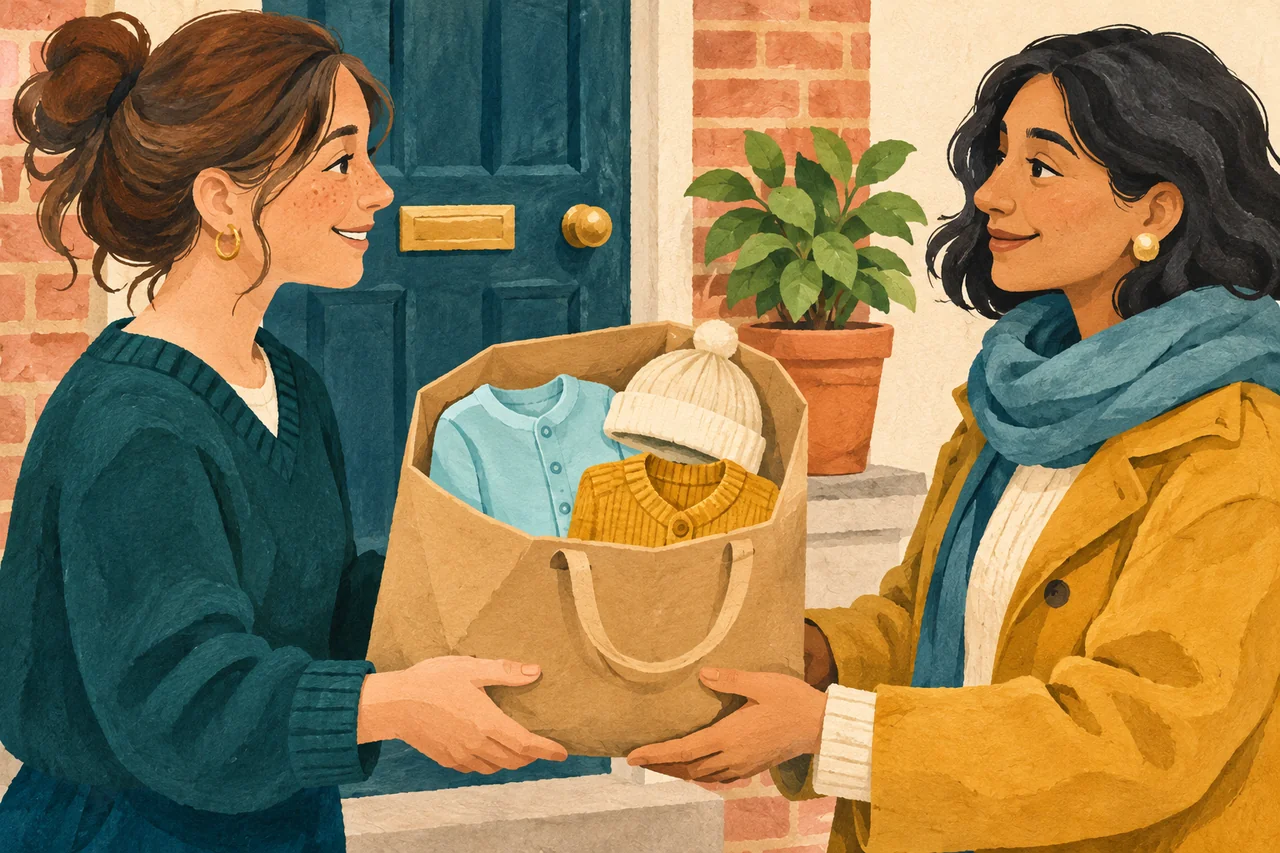
In the UK, you can donate baby clothes directly to another family, to a baby bank that needs them or to a charity shop that accepts children's clothing. Start with the clothes' condition and your preferred handover: arranging a collection with one family is different from dropping a bag at an organisation.
A small, clearly described bundle is easier to understand than an unsorted bag. Keep usable clothes together by labelled size, explain any marks and choose one route you can follow through. This guide helps you make that choice and prepare the clothes for their next home.
We checked the linked organisations' guidance on 13 November 2026. Donation needs, opening times and acceptance rules can change, so confirm them with the organisation before travelling.
Choose the donation route that fits your situation
| Route | What happens to the clothes | Useful when |
|---|---|---|
| A local family | You describe the bundle and agree a handover directly | You can answer questions and arrange collection |
| A baby bank | The organisation passes suitable essentials to families it supports | You can follow its current donation list and drop-off process |
| A charity shop | Suitable clothes can be sold to raise money for its cause | You prefer a staffed donation point that accepts your items |
There is no single best route for every bag. A local baby bank may need one size but have no storage for another. A charity shop may accept a wider range, while direct sharing lets a family ask for the particular bundle it needs.
Give baby clothes directly to a local family
On YoungPlanet, giving and receiving items are free. You list the clothes, another family can ask for them, and you agree a collection time in the app. You do not have to buy membership to give an item away. Optional membership adds other benefits, including early access to new listings, but does not guarantee availability.
To start, create a baby-clothes listing with a photo of the actual items. Sign in or create an account first if prompted. A clear offer should say:
- The labelled size or sizes, such as newborn or 0-3 months.
- How many pieces are included and what they are.
- The condition, including visible marks, wear or repairs.
- Whether collection is needed or postage can be discussed.
Do not promise a full wardrobe unless that is what the bundle contains. If sizes differ between brands, explain that in the description. You can keep separate sizes in separate bundles rather than make the next parent sort everything again.
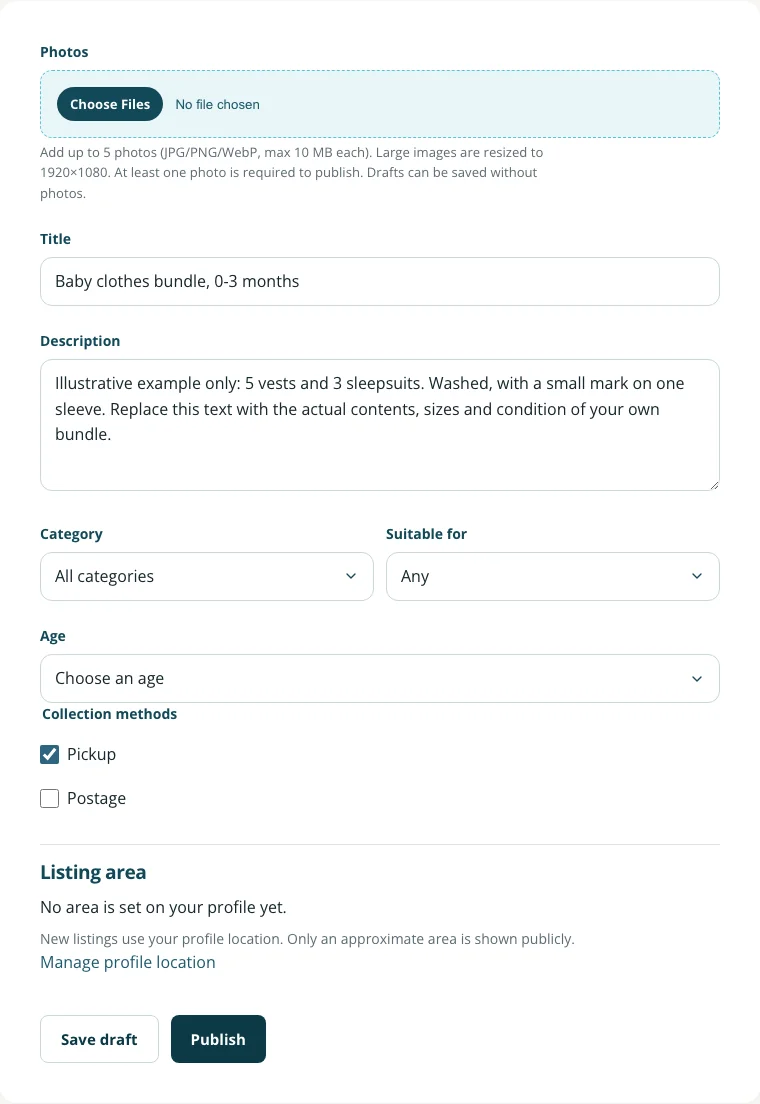
If you are not ready to publish, the form also offers a draft option. Before publishing, add the required photo and replace any example wording with the facts about your own clothes. Our listing guide explains how to describe contents and condition clearly; the same approach works for clothes.
Donate to a baby bank near you
Use the Baby Bank Alliance map to find an organisation near you. Contact it or read its current donation list before packing the car. Ask which sizes it needs, which condition it accepts and when donations can be received.
Giving clothes to a baby bank is different from asking it for help. The organisation may have referral rules for families receiving support, but as a donor your first step is its donation guidance. Do not assume a bank can accept every bag or arrange a collection from your home.
In London, Little Village accepts suitable pre-loved clothes and other essentials for babies and young children. Its website explains drop-off, postal and collection routes. Check which option suits your donation rather than assuming a collection service for large equipment also collects a small bag of clothes.
The current Little Village donation-point list includes locations in Tooting, Wembley, Camden, Wandsworth and Southwark. Use the source for opening times and temporary closures, and do not leave donations outside a closed centre.
Use a charity shop that accepts children's clothing
For a charity-shop route, check that the branch accepts clothing and has space. Oxfam's clothing guidance accepts clean children's clothes in good condition, but its bookshops do not accept clothing donations. It also explains postal donation options if a shop is not practical.
A shop donation normally supports the charity through resale. If your priority is to offer a particular bundle directly to another household, use a family-sharing route instead. Both can be useful; the important thing is knowing what you are choosing.
Baby clothes and school-specific uniform may have different acceptance rules. For older children's uniform, see free school uniform and how to pass it on, including why asking the school first can help.
Prepare a bundle someone can use
You do not need elaborate packaging. A clean bag or box and a clear description are more useful than hiding the contents under a ribbon.
- Sort by size. Read the labels and keep mixed-size items visible in the description.
- Wash and dry. Follow care instructions and make sure everything is fully dry before packing.
- Check the details. Look at fastenings, seams and loose parts. Set aside anything you cannot confidently describe as usable.
- Remove personal information. Take off your child's name labels before photographing or handing clothes over.
- Show the contents. Photograph the pieces together and add a close-up of any mark or repair that matters.
Here is an illustrative listing you can adapt. It is not a real offer:
Baby clothes bundle, 0-3 months
Five vests and three sleepsuits, all labelled 0-3 months. Washed. One sleepsuit has a small mark on the sleeve, shown in the photo. Collection by arrangement. Please check the photos and ask if you need any measurements.
Use the actual count and condition of your own items. For a bigger clear-out, sorting out outgrown clothes helps you separate keepsakes, useful donations and pieces that need another route.
What about stained, damaged or very worn clothes?
Do not put unsuitable clothes into a donation bag and leave the next person to discover the problem. A small disclosed mark may be acceptable to one family and not to an organisation, so follow the recipient's rules. Wet, mouldy or unsafe items should not be passed on as wearable clothes.
Recycle Now's clothing and textiles guidance explains routes for material that cannot be reused. Check what your local collection or textile bank accepts; a donation bank and a textile-recycling point are not always interchangeable.
Agree a clear handover
For direct sharing, confirm the bundle, collection arrangements and availability in the app before anyone travels. Share a precise address only when you are comfortable doing so, and update the other person if your plans change. A message or request does not mean a handover has been completed.
Ready with a usable bundle? List the clothes for another family. If you are looking for clothes rather than donating, use our separate free baby clothes guide or browse current clothing offers.
← Back to the blog